Saturday, 2 October 2010

'These guys play nasty'


The Special Relationship
Dir. Ricahrd Loncraine
(2010, BBC)

Britain’s relationship with America, the poodle and it’s owner.  Sheen dons the Blair grin for the third time and Dennis Quaid plays Bill Clinton with all the swagger and enthusiasm we associate with the man.    Morgan gives us his own brand of isolationistic/bi-lateral foreign/american exceptionalism policy – the script paints a lovely picture of Blair the political panther, and what got him going on his path to evil. Rather than a simple political dialogue and pseudonyms, Morgan strives straight to nuances and events that construct America and it's friend.
This is Blair’s show, we’re with him from his days as a spotty faced school boy asking for tips from the Democrats in 1993 to his carnation as P.M, and to his swift move into the dark shadows and political machinations of E.U handshakes and U.S hugs and then to that Chicago speech when Blair got the ball rolling on invasions and such like.
Akroyd’s photography is as polished as a mahogany panel in Clinton's oval office.  There are no ugly frames. Ackroyd finds wonderful composition in just two people talking. And also we have lovely details. Case in point a helicopter, so sinister as it rises from the ground its blades rotating – just a wonderfully a surreal moment. Another stand out moment Clinton riding home in his stretch limo and reflections of Washington in the window.  Ackroyd really is a man for all seasons he’ll give you hand held – frenetic war torn photography in Iraq and then he’ll give you lovely frames with subtle movements with two politicians talking in a boring room - he makes any scene work. 
Morgan always achieves the impossible of brining political heavyweights to life and why is he always so successful? The Queen, Frost/Nixon these are quality and riveting political odes, Morgan is deft at catering to his audience Who doesn't want to know how Blair and Clinton hold hands – and because middle England or any other nosey bastard is so full intrigue, every word, every action is lapped up. I can't imagine Tamara down Boujis giving a fuck about this or any of Morgan's work, because it's weight and worth is purely in the context of an audience member's expectation and knowledge of politics. I lapped it up.

Saturday, 21 August 2010

'I think we'd be great together - me and you.'


Dive
Dominic Savage
(2010 BBC)

London 2012 is upon us, thousands of athletes are undertaking the training and sacrifice that will ensue Olympic glory. Lindsey is part of this party, Aising Loftus plays a diver with hopes of representing Team G.B in 2012. It's tough for Lindsey, early starts, family troubles and the usual curiosities of a 17 year old girl. Into the mix comes Robert who manages to turn Lindsey's world upside down, more so than a quadruple double bent pike back flip off your local ten metre board. A night out on the town ends up with a romantic shag underneath the night sky with Robert.

Ok so..Dominic Savage directs, and he keeps good company, Danny Cohen D.P.s (This is England) and Ray Beckett sound mixes (The Hurt Locker). The film is beautiful, peppered with meditative shots and light kissing faces – Lindsey's brother waiting for her return from school; he loiters in the front garden and the sun light kissing is face is lovely. There's an insistence of long meandering wide shots, they come think and fast one after the other, and it's allowed because each image is beautiful, there's symmetry, poetry, everything is there to marvel at.

The film is accompanied by an abhorrent piano score, every emotional beat - we are hit with this syrupy tune which is telling us to empathise with our two leading starlets. The music is effervescent of the film's main problem, it just feels very smug. I imagine Dominic is like let me give you a snapshot of Britain, this is now, this is real, look at these real people, look at our schools, look at our beautiful English fields, look at our soldiers coming back from Afghanistan, look at the youth of day shagging like lions mating in the Serengeti. There are too many ingredients and the athlete's story is diluted into contrived shite of what is meant to be happening into Britain today.

Aising Loftus didn't look and feel like some superstar athlete, hence when she's pregnant it's like would that really happen with someone sacrificing everything for 2012. In fact maybe it could happen..but the decision to keep the baby there's the real hook, on the news of the pregnancy, I felt Aising just rubbed her tummy and went 'aww go on then...' No! Surely she'd want to get rid and get back on track for Team G.B. Suggestion to Dominic: Lindsey wants to abort and Robert disagrees, huge battle/struggle, and in the end Lindsey keeps/aborts the baby and credits role. Back to Dominic's version : after the baby's birth comes council estate and what a surprise, Lindsey's retribution, she gets back in the pool with Robert looking on in the stands cuddling the baby saying 'look at Mummy!' I didn't see that one coming..

Lindsey shouldn't be at the Olympics, look at that nice lad Tom Daley, no shagging, just hard training, he'll be on the podium come 2012 not Lindsey. I hated the film, Aising carried a smug smile, maybe that's why Dominic cast her. Luckily there's good old Eddie Marsan to weather the storm with a sterling performance as Robert's brickie dad. So the film's awful, but it's enjoyable. It's contemporary, it's ambitious, it's beautiful, so sit back and let the drab wash over you.

Sunday, 15 August 2010

'It’s not the bum territory—it’s the bum in the territory'


Salesman
Dir. Albert Maysles, David Maysles, Charlotte Zwerin
(1968, Maysles Films)

A documentary following bible salesmen. The Simpsons – the crooked salesmen you get in numerous episodes – well here they all are : Jamie Baker - 'The Rabbit', Paul Brennan - 'The Badger', Raymond Martos - 'The Bull', Charles McDevitt - 'The Gipper'. You got the seedy, desperate type, you have the macho 'I eat steak and play poker' type. All these men graft away, as they try and flog forty dollar bibles to low income families across New England and Florida.

Watching these men go about their business is all that happens in the 90 minutes. Door to door, they sell a few bibles, they struggle to sell and they sell a few more bibles. The film works and it's most definitely of a period, the suits, the motel rooms, the haircuts all feel wonderfully nostalgic and well...über cool. But man the game is repetitive, ingenious pitches of the bible and fucking over one customer after the other... Lovely photography, with the one of the salesman driving menacingly at night, and some street light kissing his face as he roams through the night, and a dark suit walking in the snow –beautiful. But come the end I was left indifferent – you know from the start who these guys are and what they're about – and maybe that's because we've seen these people hundreds of times on film and television but for me it was a little mundane.

'What does it remind you of when you hold it next to your cheek? '


Killer of Sheep
Charles Burnett
(1977 UCLA)


Charle Burnett's wonderful ode to his home town Watts, a suburb of Los Angeles. The camera dances through this black community and you simply observe people living. The film has no real narrative, we are with Stan, he works in a slaughter house, and has a wife and two children – we see him work, shop and eat. I don't know what it means or how it feels to be black and working class in L.A in the 70's, but Burnett's vignettes of this community draw you in to this world – details and moments of urban life you wouldn't get in a standard linear narrative. Like; Stan's wife doing her make up, the couple dancing to together, the children playing around the streets – every moment of these scenes are astounding.

Dinah Washington, Paul Robeson, Louis Armstrong and Earth, Wind and Fire work brilliantly with the innate images of the Watts community. Along with beautiful documentary pseudo 16mm hand held camera work, everything about the film gives a heightened sense of realism. Burnett made the film his thesis film for his UCLA MFA, and he says a lot of his contemporaries were also interested in making films about the working class, but none took this pioneering approach of Burnett-who obviously knew what it meant to be black in America at this time - the majority of the cast in this film are his friends. This film documents brilliantly life in America, observe its beauty.

Saturday, 14 August 2010

'Should we remain in Algeria? If you answer "yes," then you must accept all the necessary consequences.'


Battle of Algiers
Gillo Pontecorvo
(1966 Rizzoli)

The Algerian War, the film brilliantly depicts the rise of grass root insurgencies against the French occupation among the Algerian faithful in the city of Algiers. The National Liberation Front organise, recruit and network. French rule attempts to counter this deploying paratroopers to disrupt and eliminate the FLN leadership. Lieutenant-Colonel Mathieu, military top brass and commander of the paratroopers is the principal French character, he's eloquent and ruthless in his hunt to exterminate the FLN. The Algerian protactagonist is Ali La Ponte, a street hustler who is seduced and indoctrinated by the FLN during some time in prison. Maybe the characters provide a semblance to each movement, but it's hard to identify with either character – the film doesn't want you to either – the characters introduce the viewer into each group's world and beliefs.

The film is action, a series of events, you do not to side with either the French of the Algerian FLN. You observe what both groups are passionately perusing. The cinematography is beautiful, the black and white contrast is astounding. The visual style draws on documentary – everything about the look and feel of the film is very real. The film is kinetic, the characters are always on the move, whether it's through the beautiful stone walled side streets of Algiers or Mathieu giving a press conference walking through corridors, a wonderful scene of exposition.

The depiction of French torture becomes slightly monotonous, body after body being thrashed, the viewer becomes numb to the violence, maybe Pontecorvo's intention. There are no heroes or villains in Pontecorvo's masterpiece, of course the depiction of guerilla warfare can be used as an allegory for today's conflicts, Iraq and Afghanistan. Paul Greengrass cites Pontecorvo's work as an inspiration and it's easy to draw parallels with United 93. However compare and contrast is not necessary to enjoy this wonderful rubric of ideologies.

Friday, 13 August 2010

'The Man is Steel, The Tank is Only Iron'


Lebanon
Dir. Samuel Maoz
(2009 Metro Communications)

Samuel Maoz's personal account of his experience as an Israeli soldier during the 1982 Lebonan War. The film is confined to the interior of a tank as we follow four soldiers who eat, sleep and breath the conflict. The outside world is only viewed through the viewfinder of the tank – combined with the sounds of the hydraulic movement – it's uncomfortable. The enemy, either Syrian or Muslim Lebanese are horribly characterised – screaming inexplicably – always disillusioned. Maoz's argument is this film is his story and therefore the Lebanese are going to be portrayed in a certain light – so perhaps his contrived account of the Lebanese works.

The film comes with a beautifully minimalist soundtrack – bass beats. The story really isn't about the Lebanon War – it's an allegory for war – Vietnam – Iraq – the experiences of warfare don't change - just the landscape. Maoz's film is not a generic piece but rather an epithet of the horrors of a soldier in modern warfare.

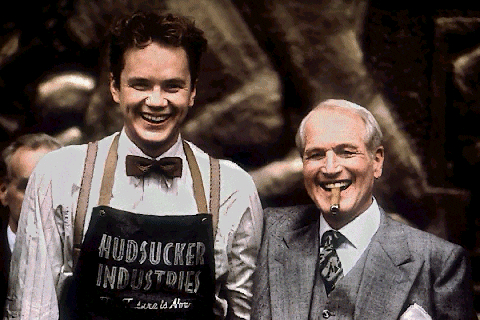
'Let's chat man to man. Now then, you're from the basement aren't you, and not blessed with much education?'

The Huduscker Proxy
Dir. Joel Coen
(1994 Warner Bros.)


A 'greed is good' tale, with Tim Robbins making the ascent from mail room boy to CEO driving Hudsucker Industries' share price into the ground – allowing Sidney J. Mussburger – Paul Newman- to buy the controlling stake in the company. With gargantuan sets, which wouldn't look out of place in Fritz Lang's M and Newman's Prince of Darkness there's plenty to enjoy. The film is a charicture of business capitalism or whatever American industry does/did so well. Robbin's playing Tim nice but dim works but perhaps is a little limited and Jenifer Jason Leigh, the love interest doing some report expose felt too familiar. Fun times though in the Coens' world of corporate chaos.

Saturday, 8 May 2010

'And there is no justice: the rich win, the poor are powerless.'


The Verdict
Dir. Sidney Lumet
(1982, Twentieth Century Fox)

An undisputed classic courtroom drama, with a hard hitting Newman performance.


The Verdict, Newman is a desperate alcoholic lawyer ins hospital negligence case. The opening title credit scene is beautiful. Newman in silhouette playing pinball, with a beer on the windowsill, the camera slowly tracks in. Cue Newman visiting funerals and flogging his business card to the bereaved. The photography in the film is astounding, Andrzej Barkowiak is the D.P. The blacks in the film are majestic, Newman's black overcoat – is horribly sinister, in fact we are in a sea of black in the funeral scenes. The final scene in the courtroom crescendos and plays brilliant, Bartkowiak's photography makes the court room look like a cathedral, Newman in pulpit with all eyes on him its beautiful- a wonderful daylight touching the frame. Again the opening scene really demonstrates the skill of Lumet's direction, no need for dialogue just action – it could work as a silent film we show Newman's desperation – and what he has to battle against in this tale of struggle and redemption – himself. Essentially The Verdict could be a standard courtroom drama, Lumet, Newman and Mamet make it extraordinary. When Newman visits a nurse asking her to be a witness in his case – it's a brilliant piece of writing abiding by the economy and simplicity – In a school playground Newman walks towards her and his plane ticket from Boston revealed in the top pocket of his overcoat– the nurse clocks this and Newman steps forward and says 'help me' – she knows what he's come here for. Newman's relationship with Laura Fischer I liked and the complications that ensured and his reaction, all brilliant, but the story should not have ended on the two of them – this was about Newman and no one else. Newman again is brilliant, the nuances he brings to Garvin's alcoholism, the walk, the breath freshener and the glazed eyes. I loved his obsession with pinball a perfect metaphor, he's desperate and yet wants to win. The bar he hangs out in serves him breakfast – a jug beer and a egg – brilliant.

Friday, 30 April 2010

'It's a young man's game'


The Colour of Money
Dir. Martin Scorsese
(1986 Touchstone Pictures)

The sequel to Newman's Hustler, Fast Eddie is back. It's 1980's and Newman has given up the game – now a whiskey dealer or something, he meets a talented player Vincent Lauria and decides to take him on the road – teaching him the tricks of the trade. Watching Scorsese's film, it's opera, it's trash, it's a wonderful celebration of the power of cinema. I'm sure a line that is used far too often, but here all the elements are at work to show you how wonderful film can be. The opening credits follow a line of smoke as Scorsese breaks down the rules of nine ball pool. It's mesmerising and beautiful seeing the smoke dance – only on film can you observe such beauty. Michael Ballhaus' camera work is outstanding weaving through pools halls to the likes of Clapton and Palmer. There's a truly magical moment when Vincent and Fast Eddie enter a pool hall on the road at the beginning of their journey to Atlanta, Clapton's 'It's in the way that use it', crescendos as the camera glides through the hall, it brought a tear my eye – it was perfection – the kinetic energy and excitement I had watching the scene. When we get to the Atlanta the camera pulls the most impressive tilt from the ceiling down onto Newman – the choreography and ingenuity is incredible. The final scene as Newman and Cruise rack up, the lights around the bar, dim down, climaxing the film, the photography is as much a wonderful character as Fast Eddie in the film. And Schoonmaker doesn't do a bad job with the editing either, unsurprisingly there are wonderful pool montages.

Richard Price is a good writer see Clockers and The Wire if you don't believe me. Here in The Colour of Money it's fast talking throughout. The whole Vincent 'I'm a jealous guy with my girlfriend' doesn't work and the stand off's with Newman and Mary Elizabeth Mastrantonio don't sit well. But the reason is more to do with Cruise's performance, here - he's a kid, but not a hungry a kid, more a spoilt brat kid. His character transition arc whatever you want to call it, happens at a flick of switch, come the end he's suddenly turned into a hustler to rival Fast Eddie – it doesn't work and it's because of Cruise's acting – nothing else. Maybe Cruise's performance is made all the more weak when your in contention with Newman, Fast Eddie second time round is vintage, Newman is truly stellar in his put downs, his attire, his white Cadillac and pool play. Cruise aside enjoy Scorsese celebrating cinema; Newman reprising arguably his most loved role and Ballhaus' photgraphy, and rock n' roll.

Thursday, 29 April 2010

' The Latin American influence has given Miami a unique flavour'


Cocaine Cowboys
Dir. Billy Corben
(Rakontur 2006)

A documentary about guys who move cocaine from Columbia to Miami. Even though these individuals were just drivers – you get the idea they still managed to have a good time. The film on one level works incredibly well with its dynamic use of archive, you really feel you're experiencing the dangers and excess of Mickey Munday and Jon Roberts. But more a criticism of the documentary's approach – the talking head interviews which are constant throughout felt a little stagnant. The set up's were so bland and generic, these characters were a lot more interesting and deserved something more than a garden tree interview – why couldn't they take us on a journey? I would have liked a bit more of engagement from both the film makers and the subjects. When Griselda Blanco pops up, the god mother who is in a nutshell psychotic evil woman – who kills more people than an American fighter drone - I began to loose interest. Much like The Kid Stays in the Picture (2002) the archive is the film's greatest strength. Cocaine Cowboys covers a lot of ground and you do get the guys story but more overview and not so much detail. That said, it still gives insight, explaining that they used to load a car's trunk with gear and then put the car on a tow truck and then get a tow truck driver to drive the truck – denying all knowledge of the drugs in the car if they were ever found - illustrates that these guys were conducting a tight operation, more details in this vein would have made a better film. I loved how when the credits roll, it's revealed Jon Roberts had been on run from the law for 6 years..no mention was made in his interview – which is emblematic to the rest of the film - more detail and engagement could have delved further into the adventures of these cocaine cowboys.

Wednesday, 28 April 2010

'Sorry I'm late. I was taking a crap '


The Sting
Dir. George Roy Hill
(19173 Universal Pictures)

Newman and the gang re-team for more glory.


It's hard not to enjoy this film when you watch the Butch Cassidy team again. Redford and Newman, Chicago, the cons and plays all carry a wonderful exuberance. The story can be explained by the insert titles which appear throughout the film, with my prologue: Newman and Redford orchestrate a con what follows : the players...the set up...the hook...the tale...the wire...the shut-out...the sting... the titles do feel a little Bugsy Malone. Why does Roy Hill have to clarify what is just about to unfold in front of my eyes. It's unnecessary and takes a little of the magic away from the story. Newman as Henry Gondorff is memorable (when is Newman not memorable?), he's here for the ride and loves the con. His game of poker with Robert Shaw, three nines, to his three jacks is a brilliantly engineered scene in the hustle and bravado of a grifter. Newman playing drunk and slapping on gin as aftershave is a nice touch. Redford is equally impressive - in one of the opening scenes he gambles and looses $6000 – he doesn't even seem to care. Redford is dashing in his pin stripe suit and always on the run from a pig by the name of Snyder. Dodging trouble whereever he goes jumping over rooftops, dustbins and railway lines, is slightly repetitive. On repetitiveness...there were a lot of dissolves which felt 1970's - if they weren't pioneering I felt they were meant to be pioneering and I didn't like it. David Ward's script verges in places on a tedious farce, Robert Shaw as the villain and his gulliblity or rather appetite for accepting the con is a bit pantomine-esque. But in other places Ward keeps the audience guessing, the FBI and the final scene work well. A fun ride.

'Why don't you pass the time by playing a little solitaire?'


The Manchurian Candidate
Dir. John Frankenheimer
(1962 United Artits)

East meets West in Frankenheimer's game of solitaire.

A cold-war political thriller with Frank Sinatra. Seeing Frankenheimer's milieu on Cold War politics back in '62 must have been pretty harrowing; the battle of ideologies East v.s West – there really is a hatred in the political rhetoric on screen. Sergeant Raymond Shaw, played by Laurence Harvy, returns from Korea, a war hero, medal of honour in hand. We learn in Korea he was captured along with the rest of his platoon and taken to Manchuria and the story unravels that Shaw has been brainwashed by communists. Everything about the film is cold, yes it's a Cold War, but there are no relationships, it's hard to identify with any of the characters – with Frankenheimer's ambition - it's all war and politics. Military and Presidential iconography peppers every scene and there's no let up, as Frakenheimer strives to illustrate the extremes and similarities of East and West ideology. Sinatra doesn't disappoint, there's a great scene when he's in a cabinet war room looking at a slide show of communists – smoke fills the air and there's a wonderful energy and pace. And he also gives a nice meet and greet with Janet Leigh on the train. But I found Laurence Harvy just incredibly eccentric and alienating as this communist sleeper agent – and Angel Lansbury as his mother was surreal. Maybe that was point – maybe my musings sound convoluted – confusion reigned in Frankenheimer's labyrinth of Pink's and Washington hawks.

Sunday, 18 April 2010

'Ding dong motherfucker... ding dong!'


The Boondock Saints II: All Saints Day
Dir. Troy Duffy
(Apparition 2009)

A hollow rehash of it's predecessor.

Back with the MacManus brothers is a painful watch second time round. The film is riddled with problems: no story, no Willem Defoe, a surreal performance from Peter Fonda bringing new deplorable depths to Italian accents. The pace feels laboured and at over two hours long, you are itching for the film to end. I could not tell you the plot – even for a suitcase full of money, a gun to my head, I still couldn't tell you. The best I can do: it's about the MacManus brothers returning to Boston. The Boondock Saints (1999) was very rock n'roll: beer, pizza, Rocco, Defoe and great gun montages lavished with spiralling guitar solos. Defoe as the detective was crazy. All Saints Day is turtle slow, the frames feel cheap – day time television is better. The brothers 10 years older, Sean Patrick Flanery and Norman Reedus, look has been's, tubby and worn, not lean and mean as they were 10 years back. At least you can take from the film what bad acting is, here we have it in bucket loads each Thespian seems to be waiting for a prompt either with their dialogue or action- there is no spontaneity – every scene feels staged and directed. Surely Billy Connolly showed up just for his fee. The shoot outs are monotonous, guys shaking their hips and falling to ground when taking lead. We are always on a close up on guys emptying rounds – there is no dynamic camera moment, or attempts to heighten the tension/action or tell the story. A very tedious affair, stick with the MacManus brothers back in 1999 when justice was served with Irish swagger.

Saturday, 17 April 2010

'The dead are dead. You ought to bury them.'


Hombre
Dir. Martin Ritt
(Twentieth Century Fox 1966)

A Newman western, it works, but it's not exciting, the plot dozes away. It literally is 6 people in a carriage, hitching a ride, getting from A – B in Death Valley country. Newman is John 'Hombre' Rusell, a white man who leaves his adoptive Apache community to live among 'civilised' people. Newman eulogises about his community but we don't see them suffer, we don't get to understand how these Indians live, the whole Apache thing appears on the surface.

Newman's performance is minimalistic and apparently based on his research of an Indian who standing outside a general store, with one foot up against the shop front and both arms crossed, hours later when Newman passed by again, the Indian hadn't moved position. Newman's stillness maybe serves to hide all the suffering he's seen, maybe you can begin to grasp the horrors of the Appache community with Newman's lifeless character. But then Newman's performance is thrown back in our face when he decides to be the hero come the credits rolling. Richard Boone's Ciero Grimes plays a great villian, he really doesn't give a shit about people, an essential ingredient for a bad guy. The women are too eloquent here for this period, Diane Cilento, articulating her place in the world to any guy who will listen...is just cringeful. Death Valley looks nice, as everyone rides this stage coach, but it's never really explored – it's wide shot after wide of the coach meandering along a track. Newman's reserved demeanour, his solemn body movements suggest an interesting and complicated character, but everything here, the actors, the landscapes all seem a little squandered.

'I used to be a sheriff until I passed my literacy test. '


Harper
Dir. Jack Smight
(Warner Bros. 1966)

Harper, Newman is a private eye detective. In interviews Newman is quoted as saying he regarded, Lew Haper, as 'pretty close to me. I didn't have to do a lot of work for that.' The man never appears to work on screen, and there's no need; he oozes class. Yes, the famous opening credits, as Newman gets ready for work and re-uses the coffee filter – immediately makes Newman's character likable – we're on his side – he re-uses coffee filters – just like us....The opening is one of the few highlights of the writing, Goldman's script feels heavy and well very 'shagadelic baby', watching this is an education in what America was like in the '60's: Diners, beaten up old gas stations, and lots of road. The plot is a kidnapping in a rich family, it's all standard fare when it comes to hiring a private detective. The chase scenes seem remarkably wooden, Newman gagged by a BFG henchman escapes, 3 minutes of chase and then Newman dodges this meat-head on top of a high platform in a ship yard and he falls to his death, it's too easy – where's the struggle? Ship yards, and other interesting landscapes, usually with machinery give a lot of pretty frames; symmetry and composition is first class with Newman on the run, photography is courtesy of Conrad L. Hall

Harper's relationship with his ex-wife, Janet Leigh is brilliant, chastising her with phone calls and general all round-misogynist behaviour. Newman preys on her late one night, and has his way with her, in the morning he discards her and the fry up she's cooked, this leads Leigh to break the yokes in the eggs she's frying – a wonderful metaphor for Leigh's fertility. True to form, Stroher Martin pops up in the film, Stoher Martin is always in a Newman film, he heads up a cult as a cover for illegal immigrants and it's endemic of Harper's frazzled plot. Goldman and Newman go onto bigger and better things.

'Sport is just a flickering moment'


Sons of Cuba
Dir. Andrew Lang
(Windfall Films 2009)

Cuban boxing has a legacy, an austerity that breeds Olympic champions. Boxers who defect to America to become professionals are considered traitors, a boxer reaches the pinnacle of his career, or rather his life when he fights for Cuba. At the Havana boxing school, we see how Cuban boxing operates and Lang's film really illuminates the boxing mantra in Cuba and how it has earned it's reputation as the leading boxing nation. Following a group of 11 year olds, they train with a fearsome hunger to win, for the glory of la patria and to get their family out of poverty. Obsessing over weight and sparring full contact these boys commence their training at 4 30 am every morning. The national championships are on the horizon, and the club has to select only a small number from the club. The coach, Yosvani Bonachea Morgan, who treats the boxers as if they were his children, has to make the incredibly difficult selection. After he announces his selection, we see him crying in a bathroom, his back turned to camera, no-one loves or takes his boxing more seriously than Yosvani. The national championships do feel like a Rocky event, but I suppose it is – it's hard not be moved and drawn into the slow motion punches and route for our team, the Havana Boxing Club.

Lang's approach to the documentary is hands-off, no voice-over or crew in sight. The film is not observational however, there are various -generic in their set up- interviews, we have the familiar competition narrative, title inserts explaining things, and a sometimes laboured soundtrack. The edit feels very smooth, almost too smooth. That said, Lang achieves a wonderful balance in his film, showing these boys' passion and dedication for their boxing, with exploring the Cuban landscape and Castro. We see poverty, and the youth indoctrination of Castro's Cuba, yet it is never out of context of the Havana boxing school and its pupils, the politics never feels forced, it's only there to serve these boys' story. An incredibly powerful scene is when one of the boys visits his father, an Olympic champion boxer, who met Castro and is now living in abject poverty. His words 'sport is just a flickering moment', resonate as we see this man suffer. Lang in a q n a after the film said he would ease off the competition build up if he were to edit again – agreed - it's a little too much a ticking clock to the competition, 4 weeks to go, 3 weeks..The competition gives the film a narrative but the beauty of the documentary are the boys and Yosvani who are brutally honest and endearing in their interviews. Lang said the interviews were shot near the end of the film's shoot, this is clear to see, as there is a trust, and wonderful relationship between camera and subject.

Friday, 16 April 2010

'I have nothing more to say on the matter'


Kings of Pastry
Dir. Chris Hegedus and D. A. Pennebaker
(Pennebaker Hegedus Films 2009)

We follow three chefs in their quest to earn a M.O.F, a three day cooking contest in Lyons, where the best crafts man in France are recognised. It's a French pastry competition but this isn't anything to do with croissants, there are 16 contestants, all could win the coveted M.O.F, but only a few will be selected by the judges. The prize? You earn the right to wear the collar of the Meilleus Ouvriers de France, the prestigious, blue, white and red collar, an unsurprising colour combination for a French cooking competition.

The three chefs we follow all have an obsession, honing their cooking, striving for perfection to perform at this competition and earn a M.O.F. Chef Jacquy Pfeiffer, founder/teacher/ of a Chicago-based French pastry school is the main subject. He obsesses over this competition, refining his sugar sculptures, cakes, Fabergé eggs, etc. His business partner at the school Sébastien Canonne, has the coveted M.O.F and acts as his mentor. While watching Jacquy's preparation, his dedication repelled rather than inspired, the sheer volume of waste he churned out, chucking recipe after recipe...A hybrid of American excess and French obsession. Regis Lazard, a second-time finalist again was obsessed over the competition but came over as slightly more human and well nice. Then there was Philippe Rigollot, a pastry chef from Maison Pic, a chef with obvious talent.

The beauty in the film, is seeing the level of obsession and men striving for excellence, it serves as a fascinating story. Competition is always a well trodden rubric for documentary, it creates drama and gives a good narrative structure: preparation – competition – aftermath. Shot on DV with a cheesy French soundtrack, courtesy of Django Reinhardt, the film could be more you-tube than cinema, and yet Kings of Pastry carries a discerning charm. The most poignant/powerful scene is when Philippe Rigollot drops his prized sugar sculpture on the last day of competition. The man proceeds to have a mental breakdown, you see him suffer, hyperventilate, struggle and panic – surely he will not get a M.O.F. But no..Philippe gets back on his horse salvages the sculpture and continues the competition. This was a beautiful scene, a man confronted with disaster and not throwing in the towel – he earns a M.O.F – and his triumph over adversity is a wonderful lesson in never conceding defeat.

Tuesday, 13 April 2010

'I'm addicted to chaos. Things in my life are going very smoothly. I'm not using anymore, but I need to get my hands dirty.'


I'm Dangerous with Love
Dir. Michel Negroponte
(Blackridge Productions, 2009)

This documentary follows a man called Dimitri, a reformed drug addict who now helps other addicts kick their addiction with his own brand of ibogaine therapy. Ibogaine is a psychoactive indoel alkaloid, in non-scientific terms: you vomit and hallucinate for up to several hours and miraculously somehow the ibogaine can remove a person's addiction – sometimes it doesn't work as the film shows.

Dimitri is one rock n' roll cowboy, being a reformed addict himself through ibogaine treatment, the man travels the country plying his ibogaine treatment. Of course his services come at price, and what he is doing is illegal in America, it's not a traditional 9-5. Dimitri is a fascinating character, a guy who seemed to party hard throughout 90s in some crazy psychedelic band, the man has also lost his girlfriend to heroine. This guy has seen a lot, the title quote are his words, and we the audience are taken on his journey, we meet different addicts Dimitri is treating; men, women, poor and poorer - all addicts, all suffering, all desperate for Dimitri's help. In Canada, Dimitri's treatment almost fucks up badly, we don't know want happens to one of Dimitri's patients, but he almost dies, whether it's cardiac arrest, withdrawal, we never know and Dimitri never knows. In the aftermath of this harrowing event, Dimtri goes to Africa to learn more about the origins of ibogaine, this is a fascinating journey as Dimtri takes part in some ibogaine ritual with a tribe – Dimitri suffers, it's harrowing, amusing and impressive. Dimitri is a confused a man, a ball of energy, he's obviously got a new addiction in helping treat addicts. The African journey, shows a commitment and fundamental belief Dimitri has in ibogaine – this you can't knock, and maybe you admire Dimitri a little for this.

Michel Negroponte provides a wonderfully sarcastic voice-over throughout film, he claims it's meant to add humour to the film's dark content, seeing a guy's heroine withdrawal I guess ain't Disney, but his voiceover really makes the whole experience of watching the film a little more uncomfortable. This isn't a criticism, the sarcasm, the epic journey we go on with Dimitri, really puts you on the edge of your seat as we watch this story unravel. Michel is obviously a committed film maker, spending four years filming Dimitri, travelling to Africa and becoming friends with his subject and even taking ibogaine to experience the hallucinogenic trip. There are similarities between Michel and Dimitri, two men committed to a cause, Michel making his film and Dimitri to his ibogaine. This film is a story about Dimitri and his commitment to spearheading an ibogaine movement not a fact finding mission into the scientific perils of ibogaine. Leaving the science out of it, the film is fascinating, wrong, uncomfortable and quite remarkable as Dimitri takes us with him.

Friday, 9 April 2010

'If someone strikes you on your right cheek, turn your other to him also. '


21 Grams
Dir. Alejandro González Iñárritu
(Focus Features 2003)

21 Grams...It's all about the interconnectedness of the world. A butterfly flaps it's wings in Hong Kong and I feel that breeze in London. Alejandro González Iñárritu's take on a car crash is ambitious, as we see how this event effects the lives of three characters. Being Alejandro, a linear narrative is not suffice to tell this tragedy, all the scenes in the story get put in the washing machine, jumbled around and taken out, therefore we watch events in a non-linear order, which though undoubtedly premeditated feels more misconstrued than anything else. It's much like downloading a file from a bit torrent client, - digesting lots of little files from many sources and only getting the complete product, when the download is completed. In 21 Grams, there are lots of little scenes with the principal characters, then come the end, we've gone full circle, and all the scenes are given a context in this suburban tragedy.

Alejandro's approach to telling this story, papers over the cracks of this rather simplified tale. I didn't care for two of the principal characters, Naomi Watts screeches and snorts a lot powder after the horrific loss of her family and Penn plays a horribly creepy man who after a heart transplant wants to track down his donor. With Watt's character – there is not enough detail, in every scene she is either hitting the bottle, or clutching one of her child's toys in the bedroom. Perhaps Alejandro's approach to the narrative forced him to make every scene service the story, every scene was symbolic of Naomi's demise and it feels one-dimensional. I didn't like the doctors in the film, all were incredibly aggressive and candid with their patient advice, the gynaecologist at the beginning didn't seem like a very sensitive gynaecologist- aren't they meant to be? Bencio del Toro is brilliant as Jack Jordon, a born again ex – con. A scene when he arrives back to tell his girlfriend that he has just run over Watt's family is harrowing and really exemplifies this man's acting talents. Again there is more brilliance at the dinner table when his son hits his daughter, and Bencio gives his children a lesson in family values. The non-liner story telling allows there to be a lot inserts and pondering wide shots as we jump from one location to the next, and the pace feels laboured. Come the end of the film, I did not care what happened to Sean Penn or Watts and Penn's epilogue is tedious. Watch it for Bencio's performance and Bencio alone.

Thursday, 8 April 2010

'What kind of bastard would break a dog's back? '


Tsotsi
Dir. Gavin Hood
(Momentum Pictures 2005)

If ever there was a film that was a honey syrup, Tostsi is it. Tsotsi's path to redemption, after shooting a mother, and stealing her car with her baby in the back seat feels stilted, just a series of scenes and details, so come Oscar season we're in with a shout. The studio was just ticking a check-list of South African clichés and heart wrenching stories. The HIV posters are carefully placed in a lot of the wide shots. No surprise it's directed by a white man, Gavin Hood, because the camera really does feel at a distance, especially in the slums - but not voyeuristic and real, more MTV music video. Hood's previous profession before directing was law, interesting because, the film does feel like an extortion of the slums of Johannesburg, everything feels used in this story of reparation.

Yet the potential for this film to succeed is clear to see, who doesn't want to see a a young boy struggling to get by in Johannesburg, fighting to survive, - it's gripping. And there are moments.. when Tsotsi runs away from the car after seeing the baby, he runs through the night sky in the pouring rain, there is an energy, it's beautiful – but it's a rare moment.

Tsotsi's dialogue with a disabled coal miner at the train station before and after he is a changed man just feels false and is systemic of the whole film. Indeed our protagonist's transformation feels just wrong, turning form nasty street hoodlum to caring youth at the flick of a switch. A poor and uncomfortable film to watch, watch Shirley Adams instead. The film has no UK distribution, but next time you're in South Africa, watch it and see real life in Johannesburg.